

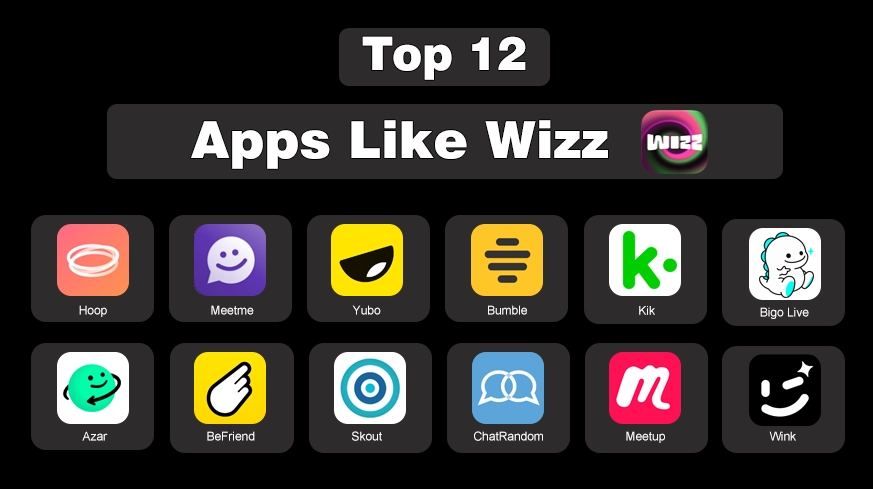

Fresh scrutiny around apps that match strangers for direct messages has pulled Wizz back into the conversation, partly because its growth story has run alongside repeated public questions about how platforms police abuse at speed. Wizz has long presented itself as a place to meet new people quickly, using swipe-style discovery and immediate chat—an approach that can feel frictionless on good nights and messy on bad ones. The renewed focus has also been sharpened by the record of platform enforcement: in early 2024, Wizz was removed from Apple’s App Store and Google Play amid sextortion concerns highlighted in reporting tied to an NCRI analysis, before returning after additional safeguards were discussed publicly.
That arc is why “Best Social Chat Alternatives” is not just a matter of features. It is also about what users, parents, schools, and app-store gatekeepers now expect to see in place before a social chat product is treated as ordinary. The result is a crowded field of substitutes—some built around live video, some around “add me” mechanics that push connections onto Snapchat, and some that simply turn interest-based communities into a private inbox.
Why Wizz is the reference point
The core mechanic people copy
Wizz is built around fast social discovery: profiles surface, a decision is made in seconds, and messaging follows. Australia’s eSafety Commissioner describes it as operating in a way that can resemble dating apps, with users swiping through profiles that typically show a photo, first name, age, location and interests before choosing to message or keep swiping. Apple’s App Store listing also frames Wizz around swiping to find friends who are online and moving straight into chat.
That structure matters because the “Best Social Chat Alternatives” conversation often begins with the same premise: less public posting, more private contact, faster. It is efficient, and that efficiency is the point. It is also the part that is hardest to moderate without slowing the product down.
Safety claims are now part of the product pitch
Wizz has increasingly described safety as central to its brand, not a footnote. On its “How it works” page, Wizz says it requires a birth date and a “clear face scan” to verify age through a biometric age-verification system, and it describes extensive content moderation tools and processes. Apple’s listing similarly markets age-matched chatting as a core feature aimed at keeping conversations among peers.
For “Best Social Chat Alternatives,” this is the new baseline language. Apps are no longer competing only on how quickly strangers can meet; they are competing on how convincingly they can describe barriers against impersonation, grooming, and scams. The gap between policy language and lived experience is where criticism tends to land.
The app-store removal changed the tone
In early 2024, Wizz was removed from Apple’s App Store and Google Play, with reporting tying the move to sextortion concerns and citing an NCRI report that flagged Wizz’s visibility in that pattern. The same reporting noted statements from Wizz’s owner, Voodoo, describing work with Apple and Google and pointing to “extensive safeguards,” alongside mention that Wizz later returned after review and additional safeguards were announced.
That episode tightened the frame for “Best Social Chat Alternatives.” It turned a generic debate about teen social apps into a more procedural question: what, exactly, triggers removal—and what satisfies reinstatement. The public record still shows only parts of that process, which keeps speculation alive.
Messaging-first platforms create a specific risk profile
Parent-focused explainers have described Wizz in plain terms: a messaging-based platform where meeting new people is the primary function. The eSafety guide goes further, noting that services like Wizz can involve location sharing, messaging, photo/video sharing, and other behaviors that can raise stakes when strangers are involved.
This is why “Best Social Chat Alternatives” often splits into two camps. Some substitutes try to keep the stranger-meeting energy but add more verification or moderation. Others avoid stranger discovery entirely, pushing people back toward existing networks—friends-of-friends, school communities, or interest groups—where identity can be softer-verified socially rather than technically.
Wizz’s “no likes” positioning echoes across rivals
Wizz’s own marketing has leaned into the idea of connection without the pressure of public metrics—less about likes and follower counts, more about direct interaction. That framing is not unique, but it has become a recognizable stance for apps chasing the same audience. It also shapes what people mean when they say “Best Social Chat Alternatives”: not necessarily quieter, but less performative.
Still, the public conversation is rarely about aesthetics alone. When a product is designed for rapid contact, the operational question becomes whether moderation can match the pace of introduction. If it cannot, brand language starts to read like a liability rather than a promise.
How “alternatives” actually differ
Swipe discovery versus community entry
One reason “Best Social Chat Alternatives” is hard to pin down is that the market is mixing two models that feel similar in practice. Swipe discovery offers a stream of individuals and a private channel. Community entry offers a room first—topic, server, group—then private messages later, sometimes after a user has been visible to others for a while.
The difference is subtle until something goes wrong. With swipe discovery, the first meaningful contact can be one-on-one. With communities, early behavior is often semi-public, which can discourage some abuse while enabling different kinds of pile-ons. Neither structure guarantees safety; both simply move the risk around.
Live video is a different kind of pressure test
A large slice of the “Best Social Chat Alternatives” market leans on live video rather than text-first messaging. Wikipedia’s overview of Yubo, for example, identifies live streaming as its main feature and describes sessions with multiple streamers and an audience that can interact. This format can feel closer to a group hangout, and it can reduce the intensity of instant one-to-one intimacy—at least at the start.
But live video also raises moderation complexity. Text can be filtered and reviewed in familiar ways; video is harder to parse at scale in real time. The shift to live does not remove risk. It changes the timeline, and it changes what evidence exists after the fact.
“Companion” apps route everything to Snapchat
Some substitutes are not trying to replace Snapchat at all. They are trying to feed it. SmartSocial describes Hoop as a companion app designed to help teens find and add new friends on Snapchat by swiping through profiles, while emphasizing it is not owned by Snapchat. APKMirror’s app listing similarly describes a flow where users request someone’s Snapchat and, if accepted, add them there.
In the “Best Social Chat Alternatives” debate, that structure matters because the most consequential conversations may happen off the originating platform. Accountability becomes layered: discovery happens in one app, but messaging and reporting may happen somewhere else. It can be efficient. It can also complicate oversight.
Age gates are becoming a product identity
Yubo is frequently discussed with age segmentation front and center. Internet Matters describes Yubo as an 18+ app that encourages users to find new friends via swiping to connect, message, and live stream. Whether every user experiences it that way in practice is a separate question, but the public-facing positioning signals how the industry is reacting to criticism: by drawing harder lines around who a service is for.
This trend reshapes “Best Social Chat Alternatives” into a sorting problem. Some platforms want the teen audience and promise guardrails. Others step back and build for adults, betting that policy and enforcement will be less punishing when minors are not the core market.
Store policies and public pressure steer product design
The Wizz removal and reinstatement cycle made clear that app stores are not passive shelves for social chat products. For companies chasing the same audience, that translates into feature triage: what is allowed to ship, what must be delayed, what needs default-off settings, what requires more verification. Some of these changes are visible; others are not.
This is part of why “Best Social Chat Alternatives” keeps resurfacing as a story rather than a one-time list. The products shift under pressure. What looked like a straightforward messaging app six months ago can return with tighter onboarding, heavier moderation, or different discovery rules—and the public is left to infer what prompted the change.
The names most often cited
Yubo, built around live “hangouts”
Yubo sits near the center of the conversation because it offers discovery but emphasizes live interaction. Wikipedia’s entry characterizes live streaming as the main feature and describes multi-person sessions with viewers who can comment and connect. Internet Matters similarly frames Yubo around swiping to connect, messaging, and live streaming, and describes it as 18+.
In “Best Social Chat Alternatives,” Yubo is often treated as a substitute for people who want the social energy of meeting new contacts without moving instantly into a private DM. That is not a guarantee of anything. It is simply a different first room, with different social signals and different moderation burdens.
Hoop, where “meeting” is really an introduction
Hoop is frequently mentioned by users who want new contacts but prefer to keep the actual conversation in Snapchat. SmartSocial describes Hoop’s core as swiping through profiles and using Snapchat to connect, noting users must log in with a valid Snapchat account and that Hoop is not owned by Snapchat. APKMirror’s product description also centers the request-and-accept flow before adding on Snapchat.
For “Best Social Chat Alternatives,” this matters because Hoop is not trying to be the whole social layer. It is a funnel. That can appeal to users who trust Snapchat’s UI and social norms more than a newer app’s messaging environment, while still seeking the novelty of strangers.
Wink, blending friend-finding and dating language
Wink is another name that appears often in the same breath as Wizz because it uses similar discovery language while leaning into both friendship and dating. Google Play’s description says Wink “blends social media with dating,” and highlights posts, missed connections, interest-based chat, and discovering nearby people. Wink’s own website also presents the product as a way to make new friends—framing connection as the center of the experience.
The “Best Social Chat Alternatives” appeal here is breadth: not just swiping and messaging, but a feed-like layer that can soften the first contact. Still, broad surfaces can also widen what moderation must cover, especially when local discovery is involved.
“Stay where you already are” alternatives
Not every alternative is a dedicated “meet strangers” product. Some of the most common substitutes are simply messaging inside platforms that already hold a user’s social graph—where discovery happens through mutuals, replies, or group participation, then shifts into private chat. In practice, this can reduce the shock of total anonymity, even if it does not eliminate deception.
This strand is a quiet part of “Best Social Chat Alternatives.” It is less exciting than a swipe deck. It also reflects a reality that many users do not actually want a brand-new place to talk—they want a safer-feeling path to the same outcome: a new conversation that does not start in public. The risk is still there. The entry point is different.
The industry’s open question: where accountability lives
As the market fills with substitutes, the core tension is not which interface is smoother. It is which company ends up responsible when discovery and messaging are split across products. Hoop-style funnels push the conversation elsewhere. Live-first apps change what “evidence” looks like when something is reported. Swipe-first apps compress the timeline between introduction and intimacy.
That is why “Best Social Chat Alternatives” remains an unsettled category. The apps are not just competing with Wizz; they are competing with the idea that any single platform can own the entire safety problem end-to-end. The public record rarely shows the full chain.
What the public record still can’t settle
Verification is described, but outcomes are harder to see
Wizz says it uses biometric age verification through a face scan, and it emphasizes moderation systems and processes as part of “uncompromised safety.” Those statements are concrete as product claims. What is less concrete, publicly, is how those systems perform across regions, languages, and spikes of abuse—details that typically live in internal metrics or confidential trust-and-safety reporting.
So “Best Social Chat Alternatives” becomes partly about credibility. When an app markets safety as a signature feature, every high-profile incident is read as evidence for or against the entire proposition. The public cannot easily audit the counterfactuals: what was prevented, what was caught early, what was missed.
App-store enforcement is visible, criteria are not
The Wizz removal from Apple and Google stores in January 2024 is an observable event, and reporting connected it to sextortion concerns raised in the context of NCRI analysis and broader child-safety pressure. What remains less visible is the standard applied across apps. What, precisely, is enough to trigger removal? What remediation is enough for a return? What timelines are expected?
This opacity shapes “Best Social Chat Alternatives” in a specific way. It rewards products that can survive sudden policy shifts and reputational hits. It also encourages rivals to copy the language of compliance, whether or not their internal systems are comparable. The store page becomes part of governance.
Youth-targeted social discovery is under constant redefinition
Wizz’s own positioning has described connection for young people and emphasizes a space for expression and social interaction. Parent-facing explainers similarly describe it as a messaging-based platform available on iOS and Android. The category it sits in—teen and young adult social discovery—has become politically and culturally charged in a way that forces constant redefinition.
That leaves “Best Social Chat Alternatives” as a moving target. An app can change its stated audience, raise age thresholds, add verification, or redesign discovery, and still be judged through last year’s headlines. The public record often lags the product. The product often outruns the policy debate.
The “dating app” comparison keeps returning
The eSafety Commissioner explicitly notes that Wizz functions in a similar way to dating apps, with swipe-through discovery and direct messaging. That comparison persists because the behavior pattern is familiar: curated profiles, quick judgments, private chat. Even when a platform rejects the dating label, the mechanics can pull the conversation back to it.
For “Best Social Chat Alternatives,” the dating-app analogy is not just semantics. It affects how parents interpret the product, how schools talk about it, and how journalists frame harm. It also affects what safeguards are expected by default—identity checks, age segmentation, reporting workflows, and moderation staffing that can keep up with real-time introduction.
Where this category likely heads next
Social discovery apps are trying to occupy a narrow lane: fast connection without the public performance layer, and enough guardrails to satisfy app stores and regulators. Wizz’s public record—growth claims, safety claims, and the documented removal/reinstatement episode—shows how fragile that lane can be when outside scrutiny intensifies.
The most plausible near-term change is not a single winner among the Best Social Chat Alternatives. It is fragmentation: more apps that do only discovery, more apps that do only conversation, more reliance on legacy platforms to finish the relationship, and more pressure on verification systems that are easy to describe but difficult to prove externally. The unresolved piece is structural. The public can see what these apps promise, and it can see when gatekeepers intervene, but it still cannot see the full mechanics of why some designs survive scrutiny and others do not.